


Choosing a solar kit might be overwhelming. Get the size wrong, and you're left with dead batteries or wasted money. A solar power system consists of several components, including a battery, an inverter, and solar panels. It must be matched to your specific power requirements. This guide will walk you through 3 clear steps for calculating your own needs, allowing you to choose a solar kit with confidence.
What Is a Solar Panel Kit?
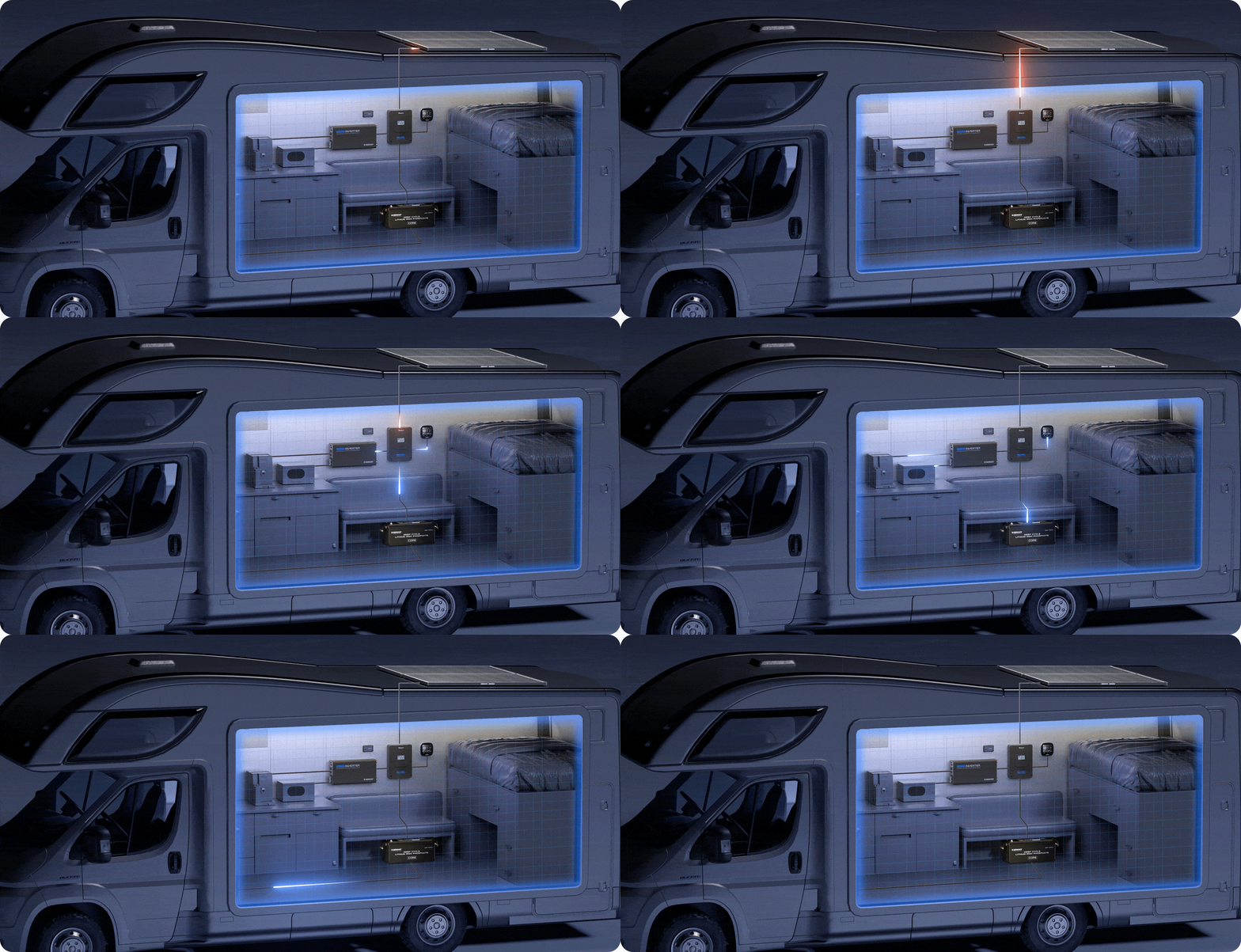
A solar kit is an all-in-one system designed to generate, store, and use electricity from the sun. Instead of sourcing each part separately, a solar kit bundles the essential, compatible components for a functional off-grid power system. A typical solar kit includes:
- Solar Panels: Capture sunlight and convert it into direct current (DC) electricity.
- Charge Controller: Regulates the power flowing from the solar panels to the battery, preventing overcharging and damage.
- Battery: Stores the DC electricity for later use when the sun isn't shining.
- Inverter: Converts the stored DC electricity from the battery into alternating current (AC) electricity to power standard household appliances.
Why You Need Solar Kits?
Investing in a pre-configured solar kit offers significant advantages over a piecemeal approach:
- One-Stop System: Everything you need arrives in one box, saving you research time and complexity.
- Cost Saving: Solar Kits are often more affordable than buying components individually.
- Guaranteed Compatibility: Renogy ensures the battery, charge controller, and inverter work seamlessly together.
- Tech Support: You can contact for troubleshooting and warranty claims.
- Simplified Installation: With matched components and comprehensive instructions, setup solar kit is more straightforward.
How to Choose a Solar System?
Follow this three-step process to calculate solar system size and find the perfect match for your lifestyle.
Step 1. Define Where the Solar Kits Will Be Used
The first and most important step is to figure out exactly how you plan to use your solar power. Your lifestyle and primary application, whether it's for a vehicle or a home, will define the system's necessary size, capacity, and overall design.
- RV: Focuses on powering household-style appliances like a fridge, lights, water pump, air conditioner, and microwave. These solar systems are typically larger, with higher capacity, and are often permanently installed.
- 4x4: Prioritizes portability, weight, and compact size. Powers essentials like a portable fridge/freezer, LED lighting, communication devices, and gadget charging. Systems are often modular and designed for rugged conditions.
- Home Back Up: Designed to power essential home circuits (e.g., refrigerator, sump pump, home networking/security) during grid outages. These are high-capacity, permanently installed systems engineered for seamless automatic switchover to maintain critical functions.
Step 2. List the Appliances You Will Run
You can't calculate watt hours for battery sizing if you don't know what you're powering. Create a list of every electrical device you plan to use and estimate its daily usage hours.

How to Find the Power Rating (Watts):
- Look for a label, specification sheet, or engraved information on the device itself.
- Use the conversion formula if needed: Amps (A) x Volts (V) = Watts (W).
|
TIPS
For appliances with motors (like fans or water pumps), distinguish between their lower running watts and their higher starting surge watts. Use the running watts for your daily energy consumption calculation, but note the surge for inverter sizing. |
Step 3. Calculate Solar System Size
This is the core of determining what size solar system you need.
1. Size Your Battery (Calculate Your Daily Energy Needs)
This part is to determine how much energy you need to store for use at night or on cloudy days.
First, you should calculate daily Watt-Hours (Wh). For each appliance: Appliance Watts × Hours Used Per Day = Watt-Hours (Wh) per Day
Then sum the Wh for all appliances to get your Total Daily Watt-Hours.
Since battery capacity is rated in Amp-Hours (Ah), you need to convert our energy needs to this unit: Total Daily Watt-Hours ÷ System Voltage (12V) = Amp-Hours (Ah) Used Per Day
Finally, add a 20-30% safety buffer for system loss and future demand.
Example:
- If your total is 1500Wh per day: 1500Wh ÷ 12V = 125Ah.
- With a 30% buffer: 125Ah x 1.3 = ~163Ah.
- You'd need a battery with at least 160-200Ah capacity.
2. Size Your Inverter (Determine Your Power Output)
The inverter converts battery power (DC) to usable household power (AC). This part determines what you can run simultaneously.
- Continuous Power Rating: This is the wattage the inverter can reliably deliver over an extended period. It must exceed the sum of the running watts of all appliances you plan to operate simultaneously.
- Surge Power Rating: Also known as peak power, this is the higher wattage the inverter can supply for a short duration to start motor-driven appliances like refrigerators, pumps, or power tools. This rating must exceed the highest starting surge watts of any single device in your setup.

Example: Running a 50W TV (50W) and a 700W microwave (700W) simultaneously requires 750W. Their highest surge might be the fridge at 1200W. Choose an inverter with a continuous rating >750W (e.g., 1000W) and a surge rating >1200W.
3. Size Your Solar Panels
To determine how much solar capacity you need to recharge your battery daily, you must account for your location's sunlight. Use the formula: Daily Watt-Hours Needed ÷ Peak Sun Hours ÷ Efficiency Factor (0.8) = Solar Panel Watts Required. Here, Peak Sun Hours refers to the average equivalent hours of full sun your location receives per day (e.g., 4-5 hours in sunny climates, 2-3 in cloudier ones), while the Efficiency Factor of 0.8 accounts for inevitable real-world losses in wiring, heat, and panel performance. This calculation ensures your solar array can reliably replenish your daily energy use.
Example: 1500Wh per day with 4 peak sun hours: 1500Wh ÷ 4h ÷ 0.8 = 469W. You'd need approximately 470W of solar panels.
Solar Kits Recommendations
Here’s how the calculation translates into real-world solar power system size needs.
Scenario A: 4x4 Weekend Warrior (3 Days Off-Grid)
Appliances
- 45L Portable Fridge: 30W, running 24 hours = 720 Wh
- LED Camp Lights: 10W, for 4 hours = 40 Wh
- Phone/Tablet Charging: 20W, for 3 hours = 60 Wh
- Total Daily Energy Need: 720 + 40 + 60 = ~820 Watt-Hours (Wh)
Translation
- Battery Size: 820 Wh ÷ 12V = ~68 Ah per day. For 3 days without sun and a safety buffer, you'd need ~200+ Ah capacity.
- Solar Power: To reliably recharge daily, a 300-400W solar panel is recommended (based on average sun hours).
- Inverter: To run small appliances (like a kettle or blender) simultaneously, a 2000W inverter offers comfortable headroom.
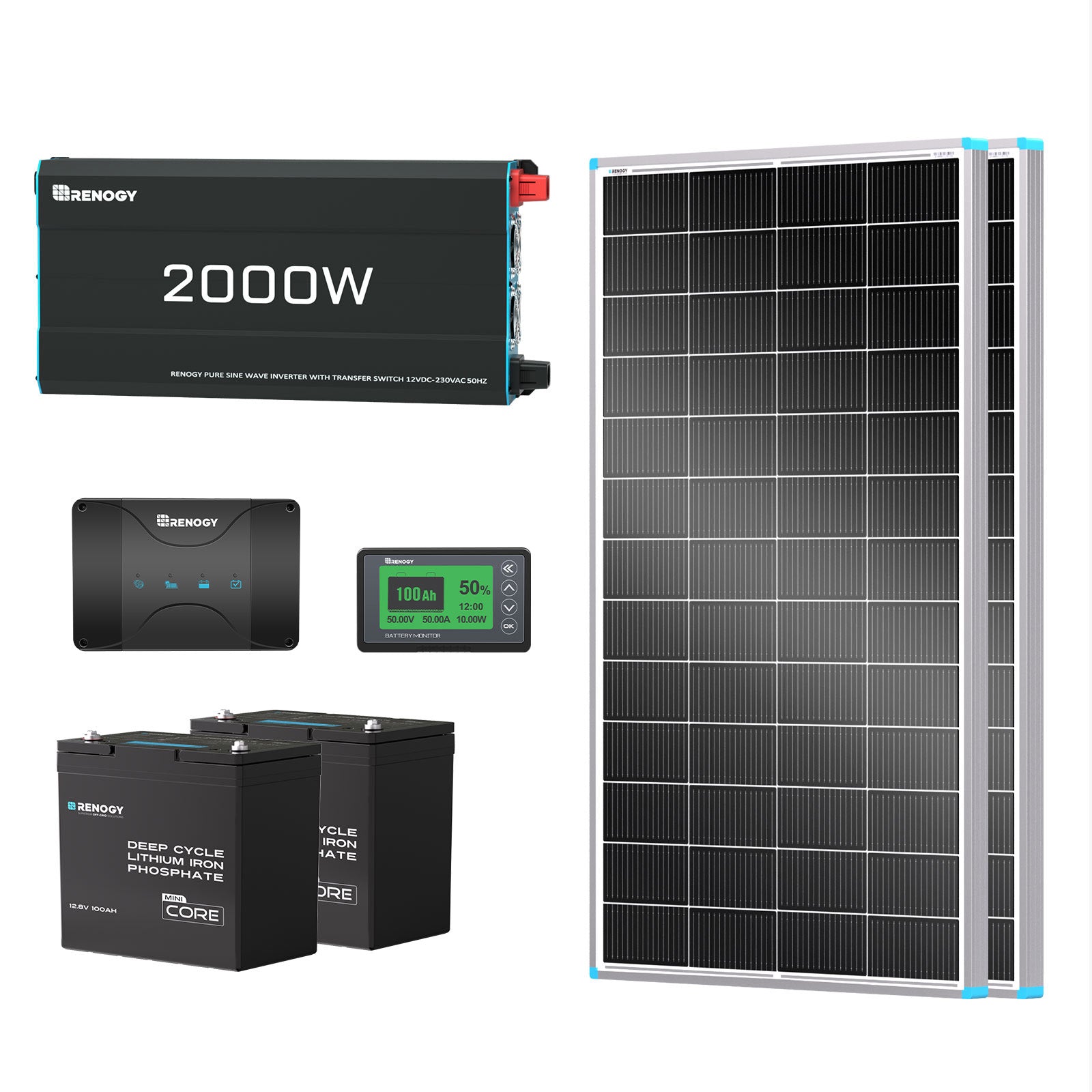
Based on your calculated demands, we propose using an all-in-one solution such as the Renogy 200Ah Lithium Power Kit. Here's how its specifications match your experience and provide outstanding value:
| Your Calculated Need | Renogy 200Ah Kit Spec | Why It's a Great Fit |
|---|---|---|
| ~200+ Ah Battery | 2.56 kWh (200Ah) LiFePO₄ | Provides ample power for 3+ days, exceeding your baseline for peace of mind. |
| 300-400W Solar | 400W N-Type Solar Panels | High-efficiency panels recharge the battery faster, even in less-than-ideal light. |
| 2000W Inverter | 2000W Pure Sine Wave Inverter | Safely powers sensitive electronics and lets you run small kitchen appliances. |
| Efficient Charging System | 40A DC-DC & MPPT Controller | Charges from both solar and your vehicle's alternator while driving. |
Scenario B: RV Family Week-Long Trip
Now list your core appliances and estimate daily use. Here’s a typical calculation for a family RV:
| Appliance | Power (Watts) | Hours Used/Day | Daily Energy (Watt-Hours) |
|---|---|---|---|
| 12V Fridge | 60W | 24 hours | 1,440 Wh |
| LED Interior Lights | 30W | 5 hours | 150 Wh |
| Water Pump | 60W | 1 hour | 60 Wh |
| Laptop / TV | 100W | 4 hours | 400 Wh |
| Microwave | 700W | 0.5 hours | 350 Wh |
| Total Daily Energy Need | ~2,800 Wh | ||
Translation
- Battery: 2,800Wh ÷ 12V = ~233Ah.Adding a 20-30% buffer for efficiency and future use leads to a recommended 300Ah (3.84kWh) lithium battery.
- Solar Panel: To recharge daily (4 sun hours): 2,800Wh ÷ 4h ÷ 0.8 = ~875W. A 600W array is a strong foundation, supplemented by driving or occasional shore power.
- Inverter: Must handle simultaneous loads (e.g., microwave + lights). A 2000W pure sine wave inverter is ideal.
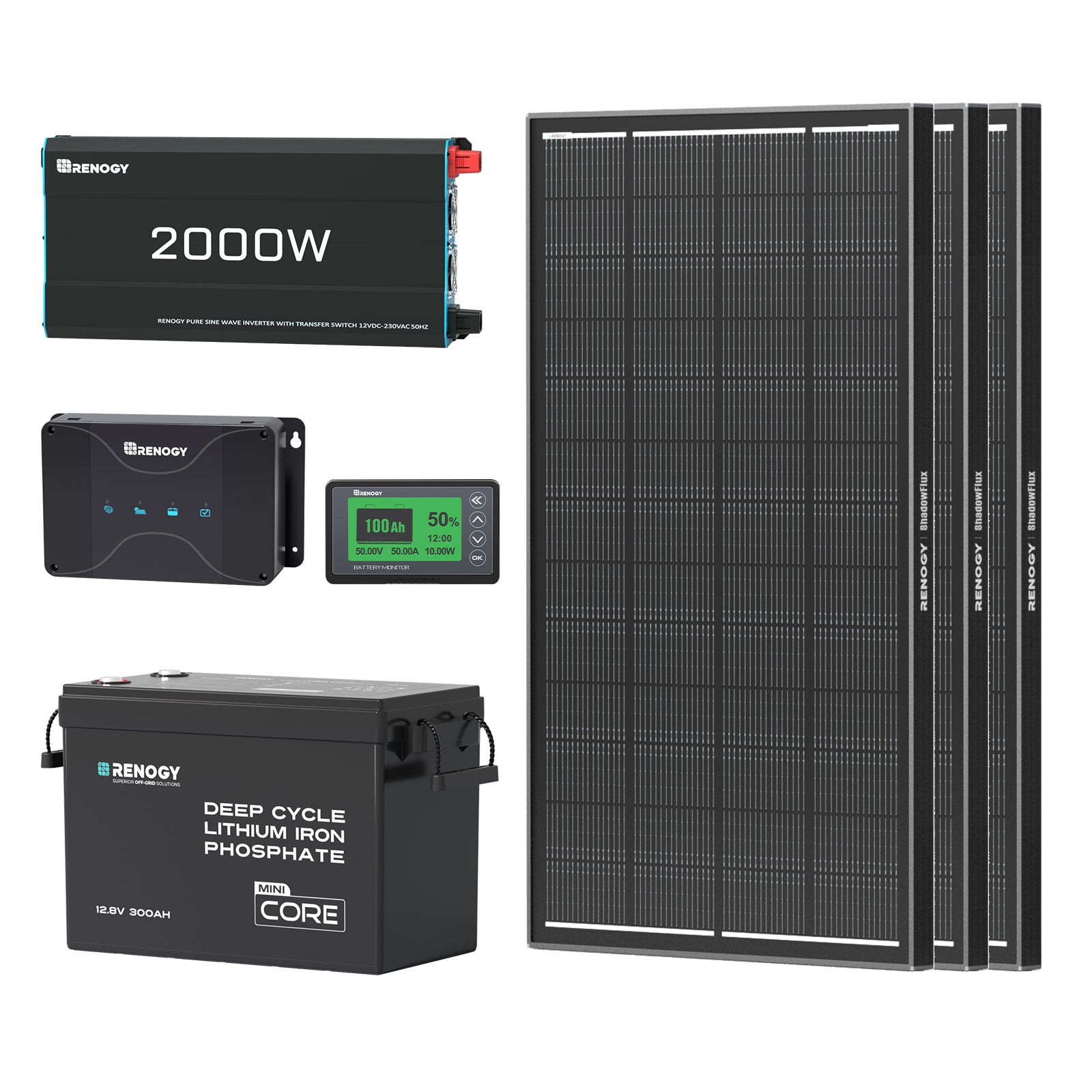
For this profile, we'd recommend the Renogy 300Ah Lithium Power Kit. It's engineered for your off-grid lifestyle.
✅ Perfect Capacity: With 3.84kWh of LiFePO₄ storage and a 2000W inverter, it reliably cover your ~2,800Wh daily load.
✅ Travel-Optimized: 600W ShadowFlux solar panels perform better in partial shade; the DC-DC charger tops up the battery while driving.
Scenario C: The Full-Time RVer or Remote Homeowner
If you live full-time on the road or off-grid, you need power that supports a complete lifestyle. Here's how to choose the right solar system.
| Your Calculated Need | Required System Scale | Renogy Solar Kit Spec | Why It's the Right Fit |
|---|---|---|---|
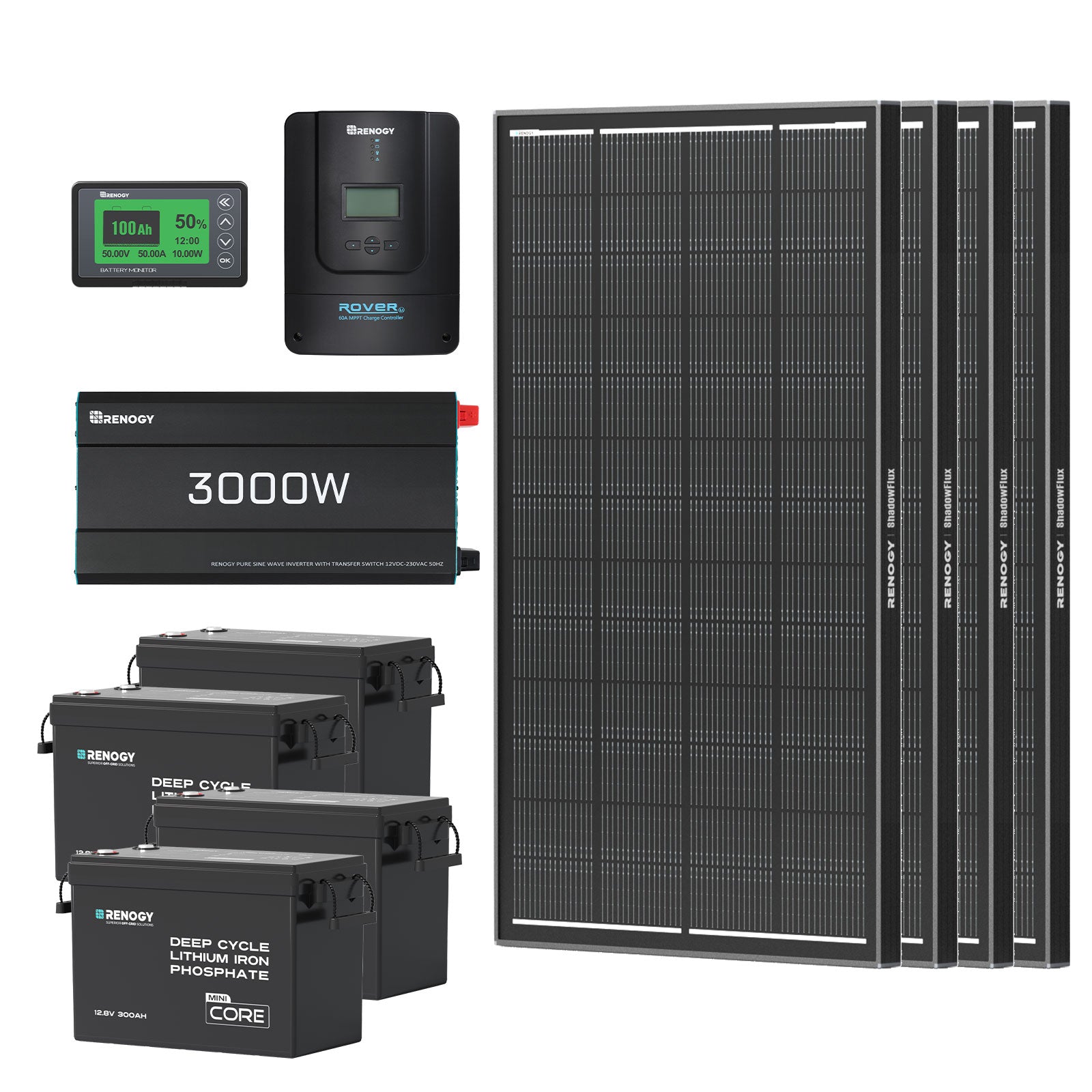
| Daily Use: 5,000Wh+ | Battery: 15-36kWh Bank | 15.36kWh LiFePO4 Battery | Engineered for Your Load: Provides multi-day autonomy in poor weather. The large LiFePO4 battery bank supports high-load appliances while maintaining voltage stability, even in hot conditions or partial shade. This ensures your essentials (like the fridge) run without interruption. |
| Peak Load: Kitchen + AC | Inverter: 3000W+ Pure Sine Wave | 3000W Pure Sine Wave Inverter | Delivers True Independence: Handles simultaneous high-demand appliances (e.g., induction cooktop + microwave) without a hiccup. The pure sine wave output is safe for sensitive electronics, enabling longer, undisturbed stays in remote locations with quiet nights and consistent power. |
| Recharge Rate | Solar: 1500W+ Array with high-amp MPPT | High-Efficiency MPPT & Compatibility with High-Power Solar Panels (e.g., ShadowFlux N-Type) | A Long-Term Asset: Captures enough sun in 4-5 peak hours to refill your large battery bank daily. With durable components, long warranties, and scalable architecture, it functions as mobile energy infrastructure that lowers long-term costs, reduces generator wear, and adds tangible value to your off-grid build. |
→ Explore the Renogy 15.36kWh Off-Grid Solar Kit
Conclusion
Choosing the right solar system size doesn't have to be guesswork. By clearly defining your needs and following the key calculation steps for your battery, inverter, and solar panels, you can confidently select a kit that delivers reliable, independent power. If you prefer to skip the calculations and jump straight to an all-in-one solution, a comprehensive solar kit is designed to handle everything seamlessly.


